IT Financial Management vs. Business Intelligence: Understanding the Difference
While IT Financial Management may sound similar to Business Intelligence (BI) in terms of data collection and reporting, the two are distinct in both purpose and depth. BI tools aggregate and display data from various systems, providing a snapshot of operational metrics. However, ITFM goes beyond mere data extraction, enabling a deeper analysis of financial relationships, cost drivers, and value chains within IT operations.
IT Financial Management doesn’t just present raw data; it interprets and configures it to reveal complex interconnections across the IT landscape. Where BI tools primarily display information, ITFM tools process and analyse it, building a granular view of cost relationships within IT services. This involves calculating unit rates and value chains for every step in the IT service delivery process. ITFM examines direct and indirect connections across resources, providing a complete picture of the true cost and value of IT investments.
In short, BI tools show what is happening in terms of data trends, while IT Financial Management goes deeper, explaining why costs are incurred, how they are related, and which business units are driving them. This added layer of analysis enables businesses to pinpoint inefficiencies and make targeted improvements, which is invaluable for organisations seeking to optimise their IT spending.
Why ITFM Provides Unique Value Beyond BI
The real advantage of IT Financial Management lies in its model-solving process, where it calculates unit rates, defines value chains, and allocates charges for each business unit. This process, unique to ITFM, gives companies an unparalleled level of insight into cost structures, creating data rather than merely displaying it. Unlike BI, which extracts and transforms existing data, ITFM is a dynamic solution that generates actionable insights through its calculations and configurations.
This capability allows ITFM tools to consolidate, standardise, and ultimately reduce IT expenditure by exposing the true cost of services. IT leaders can use ITFM insights to drive savings and optimise investments, moving beyond surface-level metrics to understand the impact of every dollar spent on IT. With ITFM, companies can make data-driven decisions on resource allocation, prioritise future investments based on ROI, and ensure that IT spending aligns with business strategy.
Why BI Alone Is Insufficient for ITFM
A primary limitation of relying on BI alone is that BI lacks the modeling capabilities needed for detailed IT cost analysis. ITFM, on the other hand, is purpose-built to calculate cost relationships, value chains, and allocations. High-quality ITFM solutions often integrate embedded BI tools, allowing users to connect external BI platforms for custom analytics. This flexibility lets users harness the power of their preferred BI tools without sacrificing the depth of insights provided by IT Financial Management.
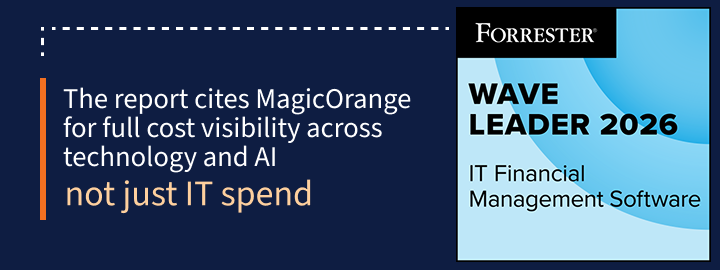
Leading ITFM solutions, such as MagicOrange, combine the ease of BI data visualisation with powerful model-driven analysis. These platforms manage the underlying infrastructure, ensuring performance, scalability, and security, while giving users control over customised reporting and insights. By allowing end-users to build and tailor reports, MagicOrange enables IT and finance teams to focus on core objectives, from strategic planning to customer satisfaction, without being bogged down by non-essential technical complexities.
SaaS IT Financial Management Solutions: Enhanced Flexibility and Control
Modern SaaS-based ITFM solutions provide the added benefit of flexible data modeling to address various business questions. These tools offer pre-built models that help IT and finance teams answer complex financial questions and uncover cost-saving opportunities across different parts of the business. Unlike traditional BI tools, which require extensive customisation to adapt to IT financial management needs, SaaS ITFM solutions are designed specifically for this purpose, allowing organisations to integrate new data sources and analyse financial trends in real-time.
In addition to cost transparency, SaaS ITFM tools can also provide advanced cost allocations and chargeback capabilities, enabling a deeper level of financial control and accountability across business units. With these capabilities, ITFM helps businesses identify wasteful spending, uncover cost-saving opportunities, and make financially sound decisions on IT investments.
Conclusion
While Business Intelligence has a vital role in data visualisation and reporting, it falls short in meeting the needs of IT financial management. ITFM goes beyond simple data extraction, providing organisations with a dynamic, granular view of IT costs and the relationships between various IT services and resources. By uncovering cost drivers and creating actionable insights, ITFM empowers businesses to reduce unnecessary expenditures, drive savings, and align IT investments with strategic objectives.
For businesses looking to make the most of their IT budget, IT Financial Management offers the tools and insights needed to drive value from existing IT assets while planning for future investments. Whether as a standalone solution or alongside BI, ITFM provides a comprehensive approach to IT financial management, equipping organisations to make informed, impactful decisions in an increasingly technology-driven world.